Painting the Grandmother Tree: behind the art of an Old Rows game
How a single gnarled tree became a five-by-four game, from the first written scene to the choice of four symbols and a palette of moss and straw.
Every game in Tinpail Orchard starts as a short piece of writing, long before there are any reels. Grandmother Tree was one of the first we wrote, and it changed more than most along the way. This is a look at how it came together, as an example of how all thirty games are made.
Starting with a scene
The first draft was only a paragraph. It described an apple tree so old that its trunk had split and hollowed, held up by forked poles, standing alone at the top of the Old Rows. It still fruited every year. Every year someone in the family worried it would be the last.
That paragraph did a lot of work. It told us the game would be in the Old Rows lane. It told us the mood: affectionate, a bit wistful, slow. It suggested a character, someone small enough to climb an ancient tree without breaking anything, which became Wren, the youngest of the family. And it suggested the game would need patience, which pointed toward high volatility.
Picking the layout
Grandmother Tree uses five reels and four rows. We wanted the screen to feel taller than the standard five-by-three games in the same lane, because the tree is the biggest thing in the Old Rows and needed room to spread. A six-reel layout felt too wide, almost like a hedge rather than a single tree. Five by four gave a squarer frame, closer to the shape of a crown of branches.
Choosing the four symbols
Each orchard game uses four regular symbols drawn from a shared set of emblems, plus a wild and a scatter with themed names. For Grandmother Tree we wanted every symbol to say something about age.
- The apple stayed, but it became an apple from the oldest limb, small and striped rather than glossy and perfect.
- The crown became a crown of leaves, a nod to the tree being the queen of the rows.
- The ring became a cross-section of growth rings, one of those ideas that seemed obvious the moment someone said it.
- The hourglass stood in for all the years the tree has stood there.
We tried other symbols along the way. A key was considered, for the idea of the tree as the key to the whole orchard, but it felt too clever. A moon was considered for the tree in winter, but it pulled the mood toward night, and this is a daytime game.
Naming the wild and scatter
The wild is the Hollow Heart, after the rotted-out centre of the trunk. It fits the wild's job nicely: an empty space that can stand in for anything. The scatter is the Propping Pole, the forked branch that holds up the heaviest limbs, because in a way the bonus is the thing that holds up the game.
The palette
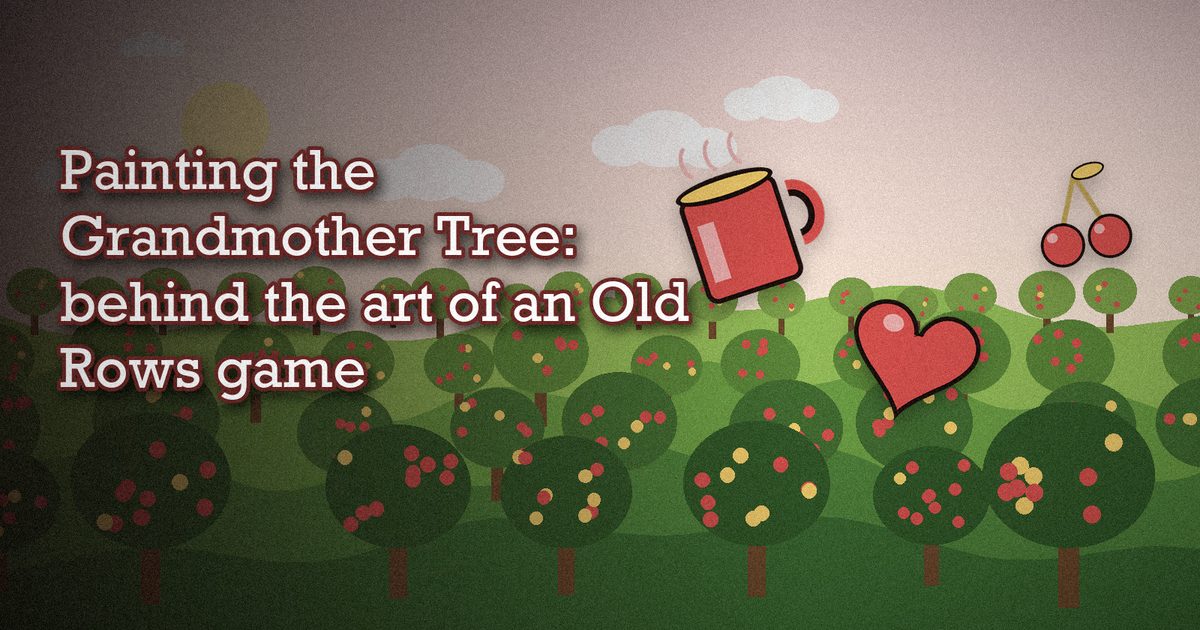
Every game has a three-colour palette: a dark background, a main colour and an accent. For Grandmother Tree we used a deep moss green for the background, close to the colour of the lichen on the bark. The main colour is an apple red, slightly brick-toned rather than bright, so it reads as old fruit rather than candy. The accent is a warm straw gold, for late afternoon light and dry autumn grass.
It is one of the darker palettes in the Old Rows, which otherwise leans bright. That felt right for a tree that sits in its own shade.
The feature
Grandmother Tree uses the Climbing Ladder: during free rounds, a multiplier starts at ×1 and climbs by one every round. In the art, the multiplier is shown climbing the propping poles up the trunk toward the crown.
We chose this feature because it suits the idea of a long climb, and because it pairs naturally with high volatility. It is worth being clear about what that means. The climbing multiplier makes later free rounds feel important, because any award that lands there is multiplied more. But whether an award lands at all is drawn at random every round, just as it is on every other spin. Plenty of free round sets end with nothing much on the higher rungs. The feature shapes the experience; it does not tilt the odds.
What we left out
The early drafts had a lot more in them: a swing hanging from one limb, initials carved into the bark, a family photograph pinned to a pole. They were all charming and all too much. A game screen needs to be readable at a glance, and every extra detail competes with the symbols. Most of that material ended up in this article and in the game's description instead.
Why we bother
None of this changes how a spin works. The random number generator does not care whether a symbol is a growth ring or a plain gem. But we think it matters that each game feels like a particular place, made with some care. When you open Grandmother Tree, we hope it feels a little like walking to the top of the Old Rows on a quiet afternoon and finding the tree still there, still fruiting, one more year.
Written by the Tinpail Orchard team.